
Bay View Analytics offers a comprehensive suite of consulting services in survey design and statistical research. Our services build on nearly two decades of research design, sampling, survey design, and statistical analysis expertise.
Only 1 in 5 say their school is ready for GenAI
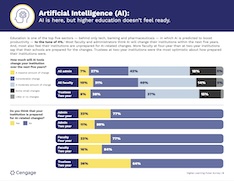
Those findings are from the 2023-2024 Digital Learning Pulse Survey conducted by Cengage and Bay View Analytics with support from the Association of Community College Trustees (ACCT), the Association of College and University Educators (ACUE), College Pulse and the United States Distance Learning Association (USDLA) to understand the attitudes and concerns of higher education instructors and leadership.
81% of Students Worry about Course Material Costs
Bay View Analytics, Affordable Learning PA (ALPA) and the Partnership for Academic Library Collaboration and Innovation (PALCI) are pleased to release the results of the Pennsylvania Course Materials Cost Survey. Results from 4,306 students across 14 institutions show the impact of course material choices on students' academic and general life. Among the findings: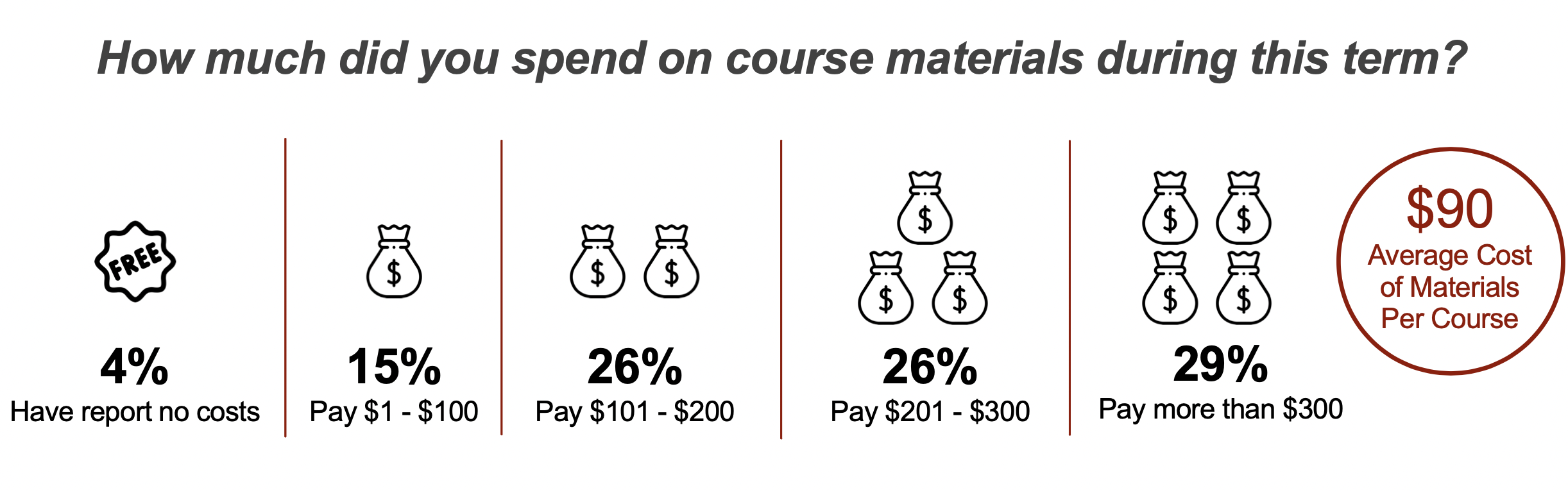
Download report: Pennsylvania Course Materials Survey 2023
Download presentation slides: Pennsylvania Course Materials Presentation
Webinar Registration.
Highest Ever OER Awareness Among Faculty

Nearly two thirds (64%) of U.S. higher education faculty are aware of open educational resources (OER) and nearly one third (29%) require an OER in their course, according to an annual survey of faculty and administrators. Both awareness and use of OER—which are openly licensed and thus free to use, edit, and share—jumped by seven percentage points compared to the 2021-22 school year, reaching their highest levels seen in the 12 years the survey has been administered.
Other key findings include:
• Faculty are most commonly using digital tools, like digital textbooks and homework software, to replace print tools like physical textbooks and homework handouts. But a small number of faculty are also utilizing new tools that have no physical counterpart, such as digital collaboration tools and student progress monitors.
• Faculty are generally satisfied with the overall quality of their curricula, as 50% gave their curricula a grade of either an A or B.
Three quarters of K-12 teachers create their own classroom materials
More than three quarters (77%) of K-12 teachers create their own classroom materials to supplement or replace a textbook, and among those who do use a textbook, the same percentage (77%) offer it to their students in digital format, according to the results of an annual survey of K-12 educators and administrators. This gravitation toward self-created and digital materials is complemented by an increasing awareness of open educational resources (OER), which are free to use, edit and share. More than one in four (28%) teachers are now aware of OER and Creative Commons licensing—an uptick of six percentage points compared to the 2021-22 school year.
What We Do
Educational Research – We are a leader in survey research on current views in K-12 and higher education faculty and institutions, with a focus on open educational resources (OER).Statistical Research – We offer consulting support across all disciplines and specialize working with biotech and pharmaceutical companies.
Download Our Reports
All of our reports are free to download and use. Download our K-12 education, higher education faculty and institutions, open educational resources, research briefs, our statistical tutorials or most recent scientific publications. See recent citations and uses of our work.Partners
Bay View Analytics works with variety of companies, non-profit foundations, academic groups, reporting agencies, and more. Within our scientific projects, we work with small biotech startups to large pharmaceutical companies, in addition to academic and non-profit researchers.
Presentations
Bay View Analytics participates in multiple conferences. Our presentations cover our most current research on distance learning and open educational resources in US K-12 and higher education, as well as offering an overview of trends over the last decade.
Connect With Us
You can follow us on  Twitter and
  LinkedIn. We also invite your feedback and comments.
Recent Publications
Digital Learning Pulse Surveys
- Infographic: 2023-2024 Digital Learning Pulse Survey
- The Digital Transformation of the Community College
- Planning for a Smaller Future: Dealing with Declining Enrollments
Course Material Affordability
- Pennsylvania Course Materials Survey 2023
- Pennsylvania Course Materials Presentation
- Course Material Webinar Slides
Open Educational Resources
- Digitally Established: Educational Resources in U.S. Higher Education, 2023
- Curricula of Many Sources: Educational Resources in U.S. K-12, 2023
- Research Brief: Digital and OER Textbook Adoption
- Research Brief: Faculty Satisfaction with Course Materials varies by Publisher
STEM
- Teaching Online: STEM Education in the Time of COVID
- What Makes a STEM Student
- Perceptions of the Future of STEM Education
Distance Education
- Digital Faculty: Faculty Social Media Use and Communications
- Infographic: Digital Faculty
- Grade Increase: Tracking Distance Education in the United States
Follow us on
Twitter and LinkedIn.
Privacy
All survey respondents are provided complete anonymity. No personally identifiable information is released. Full privacy policy.